
Archive

February 2026

Browsing

TSX-V: WLR

Frankfurt: 6YL

 Walker Lane Resources Ltd. (TSXV: WLR,OTC:CMCXF) (Frankfurt: 6YL) (the ‘Company’) announces that the Company continues to work diligently toward the completion and filing of the Company’s annual audited financial statements and management’s discussion and analysis for the fiscal year ended September 30, 2025 (the ‘Required Filings’). The Company is actively working on various strategies that they expect will resolve the preparation of the Required Filings as quickly as possible.

The Required Filings are due to be filed by March 30, 2025. In connection with the anticipated delays in making the Required Filings, the Company made an application for a Management Cease Trade Order (‘MCTO‘) under NP 12-203 to the BC Securities Commission, as principal regulator for the Company, and the MCTO was issued on January 29, 2026. The MCTO restricts all trading by the Company’s CEO and CFO in securities of the Company, whether direct or indirect. The MCTO does not affect the ability of persons who are not directors, officers or insiders of the Company to trade their securities. The MCTO will remain in effect until the Required Filings are filed or until it is revoked or varied.

The Company expects to proceed with the filing of its interim first-quarter financial statements shortly after the Required Filings have been completed and submitted.

The Company confirms that it intends to satisfy the provisions of the alternative information guidelines described in NP 12-203 by issuing bi-weekly default status reports in the form of a news release until it meets the Required Filings requirement. The Company has not taken any steps towards any insolvency proceeding and the Company has no material information relating to its affairs that has not been generally disclosed.

About Walker Lane Resources Ltd.

Walker Lane Resources Ltd. is a growth-stage exploration company focused on the exploration of high-grade gold, silver and polymetallic deposits in the Walker Lane Gold Trend District in Nevada and the Rancheria Silver District in Yukon/B.C. and other property assets in Yukon. The Company intends to initiate an aggressive exploration program to advance its projects through drilling programs with the aim of achieving resource definition in the near future.

For more information, please consult the Company’s filings, available at www.sedarplus.ca.

ON BEHALF OF THE BOARD OF DIRECTORS

Kevin Brewer
President, CEO and Director
Walker Lane Resources Ltd.

Forward Looking Statements

This news release contains certain statements that constitute ‘forward looking information under Canadian securities laws (‘forward-looking statements’). The use of words such as ‘anticipates’, ‘expected’, ‘projected’, ‘pursuing’, ‘plans’ and similar expressions identify forward-looking statements. Forward-looking statements in this news release include statements regarding the application for the MCTO and the completion of the Required Filings and the timing thereof. Since forward-looking statements address future events and conditions, by their very nature they involve inherent risks and uncertainties. Many factors could cause actual future events to differ materially from the forward-looking statements in this press release. The forward-looking statements included in this news release are expressly qualified by this cautionary statement. The forward-looking statements and information contained in this news release are made as of the date hereof and the Company undertakes no obligation to update publicly or revise any forward-looking statements or information, whether as a result of new information, future events or otherwise, unless so required by applicable laws. The reader is cautioned not to place undue reliance on forward-looking statements.

SOURCE Walker Lane Resources Ltd

View original content to download multimedia: http://www.newswire.ca/en/releases/archive/February2026/13/c0056.html

News Provided by Canada Newswire via QuoteMedia

This post appeared first on investingnews.com

Albemarle (NYSE:ALB) is raising its long-term lithium demand outlook after a breakout year for stationary energy storage, underscoring a shift in the battery materials market that is no longer driven solely by electric vehicles.

The US-based lithium major reported fourth quarter 2025 net sales of US$1.4 billion, up 16 percent year-over-year, with adjusted EBITDA rising 7 percent to US$269 million.

For the full year, Albemarle delivered US$5.1 billion in revenue and US$1.1 billion in adjusted EBITDA, results that CEO Kent Masters said were supported by “strong growth in energy storage and significant cost and productivity improvements.”

But the most consequential update came in the company’s demand outlook.

“We are seeing a diversification of lithium end markets, with stationary storage becoming an increasingly significant demand driver,” Masters told investors during a February 12 conference call, adding that Albemarle has increased its 2030 global lithium demand forecast by 10 percent to a range of 2.8 million to 3.6 million metric tons.

Storage steps into the spotlight

Global lithium demand reached 1.6 million metric tons in 2025, up more than 30 percent year-over-year and in line with Albemarle’s prior projections. Demand growth outpaced supply, tightening inventories and lifting prices into year-end.

For 2026, Albemarle now expects global lithium demand to rise to between 1.8 million and 2.2 million metric tons — growth of 15 to 40 percent — driven by both EV adoption and accelerating deployments of stationary energy storage systems (ESS).

While global EV sales climbed 21 percent in 2025, energy storage was the standout. ESS demand surged more than 80 percent year-over-year, with strong growth across China, North America and Europe.

China, which accounted for roughly 40 percent of ESS shipments, saw demand rise 60 percent. North American shipments jumped 90 percent, reflecting grid stability needs and rising electricity consumption linked to data centers and artificial intelligence. European shipments more than doubled as countries expanded renewables and sought greater energy security.

Demand outside the three major regions grew 120 percent and represented more than 20 percent of global ESS shipments, with Southeast Asia, the Middle East and Australia emerging as key growth markets.

The shift is already visible in Albemarle’s financials. In 2025, energy storage volumes reached 235,000 metric tons of lithium carbonate equivalent, up 14 percent year-over-year and above the high end of the company’s guidance range.

Fourth quarter energy storage net sales rose 23 percent from a year earlier, while segment EBITDA climbed 25 percent, supported by higher lithium pricing and cost improvements.

CFO Neal Sheorey said Albemarle’s updated 2026 scenarios reflect both pricing and operational gains.

Cost discipline, portfolio reset

After weathering a sharp downturn in lithium prices over the past two years, Albemarle has focused on strengthening its balance sheet and lowering its cost base.

In 2025, the company delivered approximately US$450 million in run-rate cost and productivity improvements and is targeting an additional US$100 million to US$150 million in 2026.

Albemarle also announced it will idle operations at its Kemerton lithium hydroxide plant in Western Australia, citing a structural cost gap between Western and Chinese conversion assets.

“There is a gap there between China and the West,” Masters said, pointing to higher labor, power and waste management costs in Australia. Idling the plant is expected to improve adjusted EBITDA beginning in the second quarter, with no impact on sales volumes.

At the same time, Albemarle is streamlining non-core assets.

The company closed the sale of its stake in the Eurocat joint venture in January and expects to complete the sale of a majority stake in its refining catalysts business in the first quarter. Together, the transactions are expected to generate approximately US$660 million in pre-tax proceeds.

“We are committed to maintaining our investment-grade credit profile,” Masters said, adding that deleveraging and disciplined capital allocation remain priorities.

Growth with limited new capital

Despite pulling back on large-scale capital spending, Albemarle expects to deliver a five-year compound annual growth rate of roughly 15 percent in energy storage sales volumes, building on a 25 percent CAGR over the past four years.

Incremental expansions at the Greenbushes mine in Australia, yield improvements at the Salar de Atacama in Chile and higher utilization at the Wodgina joint venture are expected to support growth with minimal additional capital.

Looking ahead, Masters said the company is better positioned to navigate lithium’s still-maturing cycle.

“We’ve been through two cycles since the advent of EVs,” he said, describing the market as early in its development from a commodity perspective.

With stationary storage now emerging as a second structural demand pillar alongside EVs, Albemarle’s revised outlook suggests the lithium market’s next phase will be shaped as much by grid resilience and energy security as by transportation electrification — broadening the base of demand for years to come.

Lithium prices rebound sharply in early 2026

Lithium prices have surged since the start of 2026, underscoring the market’s renewed volatility.

According to Fastmarkets, spot battery-grade lithium carbonate on the seaborne market climbed from about US$11 per kilogram in early December to more than US$16 per kilogram by early January, a jump of nearly 50 percent in a matter of weeks.

The rally has been driven by tightening supply, including delays to the reopening of CATL’s (SZSE:300750,HKEX:3750) Jianxiawo lepidolite mine and maintenance at other production facilities, alongside aggressive restocking tied to long-term contract negotiations.

Speculative buying has amplified the move, with bullish sentiment and geopolitical risk adding to momentum. At the same time, thin spot liquidity reflects a cautious market, as buyers and sellers hesitate to commit amid rapid price swings.

Spodumene prices have followed suit, rising above US$2,000 per metric ton in January, levels not seen since October 2023. The rebound has improved margins for Australian producers, many of whom curtailed output when prices fell below US$900 per metric ton. Sustained pricing at current levels could prompt a wave of mine restarts, potentially easing supply tightness later this year.

Still, Fastmarkets cautioned that prices may be running ahead of fundamentals.

“Lithium prices appear to have moved ahead of the fundamentals, propelled by speculative buying, bullish sentiment and a backdrop of heightened geopolitical risk,” wrote Paul Lusty. “The key takeaway is to brace for more volatility.”

Securities Disclosure: I, Georgia Williams, hold no direct investment interest in any company mentioned in this article.

This post appeared first on investingnews.com

White House press secretary Karoline Leavitt is making an example of former President Barack Obama for encouraging voters and lawmakers to reject adopting national voter ID laws. 

‘You know how badly the Democrats are panicking when they bring out Obama to spread lies about voter ID,’ Leavitt posted to X Thursday. ‘The fact is that nearly 90% of voters support’ voter ID laws, she continued before posting two screenshots showing two polls reflecting Americans support such laws at around 83% support to 84% support. 

Leavitt’s comments follow the House passing a massive election integrity overhaul bill Wednesday, which includes requiring voters to show a photo ID when casting ballots in federal elections. The bill overall aims to prevent noncitizens from voting in U.S. federal elections, with all but one Democrat, Rep. Henry Cuellar, D-Texas, voting against it. 

Obama was among prominent Democrats encouraging House lawmakers to vote against the measure, claiming it will disenfranchise voters. 

‘Republicans are still trying to pass the SAVE Act—a bill that would make it harder to vote and disenfranchise millions of Americans,’ he posted to X Wednesday evening. ‘Join @RedistrictAct and tell your member of Congress to vote no.’ 

Democrats have argued that voter ID laws can disenfranchise eligible voters because they often require specific, current government-issued IDs that may be a struggle to obtain due to costs, paperwork hurdles or limited DMV access. Republicans have rejected that argument, calling the requirement a common-sense safeguards that would boost confidence in elections, while simultaneously noting that most Americans already need IDs for everyday tasks.

In another post, Leavitt shared that Obama presented his own driver’s license to vote in the 2012 election. Obama voted early that cycle and was seen on camera pulling his Illinois driver’s license from his wallet to flash to poll workers. 

‘Here is Barack Obama showing his photo ID to vote in a past election,’  Leavitt posted. ‘Why are Democrats in Congress so opposed to making this a requirement across the country? Voter ID laws are common sense.’ 

White House spokeswoman Taylor Rogers added that IDs are frequently used by Americans to buy alcohol or get on a plane, which she said shows the hypocrisy of Democrats pushing against the election security overhaul. 

‘Barack Obama and the rest of the Democrats think Americans are stupid, which is why they are blatantly lying about the commonsense election integrity provisions in the popular SAVE Act,’ Rogers told Fox News Digital. 

‘Americans need to show ID to buy alcohol, get on a plane, and even get into the Democratic National Convention — but these hypocrite Democrats don’t want voters to show their ID to cast a ballot. Congressional Democrats’ opposition to the SAVE America Act is indefensible and wildly out of step with the views of the American people.’ 

Fox News Digital reached out to Obama’s office Thursday for comment but did not immediately receive a reply. 

Called the SAVE Act, the legislation would additionally require information-sharing between state election officials and federal authorities in verifying citizenship on current voter rolls, as well as enable the Department of Homeland Security to pursue immigration cases if non-citizens were found to be listed as eligible to vote.

If passed, the new requirements could be implemented for the November midterm elections. It must first pass the Senate before it could land on President Donald Trump’s desk. 

This post appeared first on FOX NEWS

Lawmakers are jetting from Washington, D.C., without a deal to prevent a partial government shutdown. 

Their departure comes after the Senate was unable to send a full-year funding bill for the Department of Homeland Security (DHS) to President Donald Trump’s desk. 

Senate Democrats doubled down on their demands for stringent reforms to immigration enforcement and bucked multiple attempts Thursday to keep the agency open.

With both chambers now on their way to a weeklong recess, the agency is expected to shutter at midnight Friday. Unless a deal is struck before lawmakers return, DHS will be shut down for at least that period of time.

Senate Majority Leader John Thune, R-S.D., made the call to send lawmakers home and noted that if negotiations made a breakthrough, they would be on 24-hour notice to return. But talks, for now, are somewhere between baby steps and stuck. 

‘What it appears to me, at least at this point, is happening is the Democrats, like they did last fall, they really don’t want the solution,’ Thune said. ‘They don’t want the answer. They want the political issue.’ 

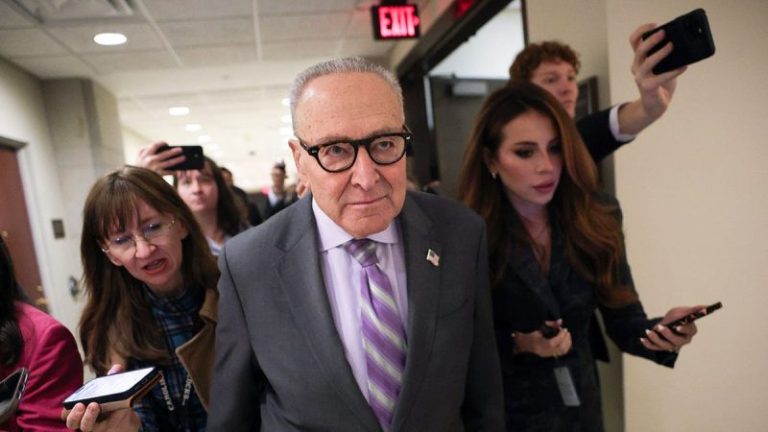
Senate Minority Leader Chuck Schumer, D-N.Y., and his caucus blocked an attempt to pass the original DHS funding bill and a subsequent two-week funding extension. 

Their resistance comes after the White House unveiled the legislative text of the administration’s counteroffer, which several Senate Democrats balked at Thursday morning. 

‘The administration doesn’t actually want to reform ICE,’ Schumer said. ‘They never do it on their own. That is why we need — we are fighting for — legislation to rein in ICE and stop the violence.’

Senate Democrats have demanded a stringent list of reforms to Immigration and Customs Enforcement (ICE). They weren’t persuaded by border czar Tom Homan that operations in Minneapolis would be drawn down as negotiations continue.

It was a déjà vu moment from months earlier, when Thune repeatedly tried to peel Democrats away from Schumer during the longest government shutdown in U.S. history but failed to break their blockade.

While there was optimism that negotiations were moving in a positive direction earlier this week, those hopes appeared to have shattered. 

‘At this point, it seems clear that the Democrats are going to walk away from that bipartisan conversation,’ a senior White House official said. ‘They’re going to shut the department down. They’re going to deprive Americans of critical services such as FEMA, such as TSA and what will be the third partial government shutdown of this Congress.’

Senate Democrats received the legislative version of Republicans and the White House’s counteroffer Wednesday night, but many said it was ‘not sufficient,’ and several Democrats leaving a closed-door meeting Thursday morning said a deal remained out of reach.

Given the stagnation in talks, Thune opted to go ahead with the scheduled recess, but made clear to lawmakers that if there was a breakthrough they would need to return.

‘Obviously, we’ve made it clear to people that they have to be available to come back and vote,’ Thune said. 

Talks of another counteroffer to the White House are in the works. Some Senate Democrats hope that the upcoming recess and likely closure of DHS will serve as a wake-up call to Republicans. 

Complicating matters is that several members of the House and Senate are expected to travel to Germany for the annual Munich Security Conference.

‘I still think the Republicans are in a bubble and do not understand the depth of the anger out there in the world,’ Sen. Brian Schatz, D-Hawaii, told Fox News Digital. 

‘And maybe this break will allow them to go home and get yelled at, not just by people who are progressive, but everybody who thinks that this agency is out of control and needs to be reined in.’

This post appeared first on FOX NEWS

: A trio of Republican senators are moving to overhaul how federal childcare funds are distributed after what they call ‘mass fraud’ in Minnesota exposed a system that paid providers before verifying children were ever in the room.

Sen. Ted Cruz, R-Texas, joined by Sens. Mike Lee, R-Utah, and Rick Scott, R-Fla., is introducing the Payment Integrity Act, legislation that would require states to distribute federally funded childcare dollars based on verified attendance — not enrollment claims.

‘Programs in Minnesota for welfare and childcare were designed to channel resources into protecting vulnerable children, but were treated like an open ATM by criminals,’ Cruz told Fox News Digital.

‘The mass fraud in Minnesota shows that American taxpayers can no longer rely on local and state politicians to prevent abuses, because those politicians often have electoral and partisan incentives to look the other way. My legislation reduces the risk of the waste and fraud we’ve seen and ensures that resources are provided to children and families who need it.’

The bill would reverse a 2024 Biden administration rule requiring states to pay childcare providers before attendance verification. Under Cruz’s proposal, providers would be paid only after services are confirmed — shifting from enrollment-based payments to attendance-based billing.

Cruz’s bill comes as the outspoken Texan led a Senate Judiciary Subcommittee hearing on alleged Somali fraudsters last week. There, lawmakers heard directly from David Hoch — a journalist seen accompanying blogger Nick Shirley to addresses proclaimed to be Somali daycares.

‘There are few crimes more morally repugnant than stealing from vulnerable children. Every dollar stolen is a meal not eaten, a doctor’s visit missed, and a future diminished,’ Cruz said, adding that such fraud ‘plunders our children’s potential.’

Gesturing towards a photo of the ‘Quality Learing Center’ in Minneapolis during the hearing, an allegedly fraudulent childcare provider Cruz called ’emblematic’ of the crisis, he said the fraud was occurring not in ‘some distant or lawless place, but in the heart of America’s Midwest.’

Co-sponsor Lee said that support for childcare should ‘go to real kids, not empty rooms.’

‘Fake childcare operations are stealing funding from the ones who are actually taking care of America’s children in need. Our bill will address this massive fraud by granting funding based on actual attendance rather than reported enrollment, and allowing states to pay retroactively instead of in advance,’ Lee said, adding such ‘diligence’ should have been the law all along.

The Payment Integrity Act also puts into law January rule from Health and Human Services that established attendance-based billing procedures

That rule, according to Secretary Robert F. Kennedy’s deputy Jim O’Neill was also spurred on by what has been happening in Minnesota.

‘We’ve seen credible and widespread allegations of fraudulent daycare providers who were not caring for children at all. The reforms we are enacting will make fraud harder to perpetrate,’ O’Neill said in a statement.

The Payment Integrity Act officially amends the Child Care and Development Block Grant Act signed into law by President George Herbert Walker Bush, to include such ‘attendance-based billing.’

‘Nothing in this subchapter shall be construed to require a lead agency to make a payment to a child care provider prior to the provision of child care services,’ the bill reads, a direct reversal of the pre-payment system Cruz says allowed fraud to flourish.

This post appeared first on FOX NEWS

A new attack ad from Republicans targeting U.S. Sen. Jon Ossoff, D-Ga., is slamming the vulnerable Democrat senator for requiring entrants at his political rallies to show proof of identification, but arguing that identification requirements for voting are a form of voter suppression. 

Want to get into a Jon Ossoff rally?’ the advertisement’s narrator begins, before it goes into a montage of staffers at Ossoff’s Feb. 7 rally asking for entrants’ IDs.

‘Don’t forget your ID’ rally staff can be heard saying as folks walked into the Georgia International Convention Center located in metro Atlanta.

‘Also, do you have your ID with you?’ another staffer can be heard asking entrants in the video captured by a GOP tracker. ‘I’ll just grab your ID from you. Thank you so much,’ another said. Please have your IDs ready, please, thank you.’

Meanwhile, Ossoff has referred to attempts to establish stricter photo-identification rules for voting and voter registration in federal elections as ‘nakedly partisan, totally unworkable, [and] bad faith.’

Ossoff’s team declined to comment for this story. 

On Wednesday, Republicans in the House of Representatives passed the latest iteration of a voter integrity law aiming at requiring stricter in-person documentation requirements, such as needing a photo-ID to vote. This bill is a broader and stricter version of the 2025 version of the bill which focused predominantly on registering to vote as opposed to the act of voting itself.

Ahead of the vote’s passage, one of Ossoff’s Republican challengers in the upcoming U.S. Senate race in Georgia, Rep. Buddy Carter, R-Ga., called out the incumbent Democrat Senator for ‘once [saying] that voter ID was ‘right and appropriate,’ [but] now supports his party as reframing it as ‘voter suppression.”

‘The law didn’t change. Public opinion didn’t change. What changed was he – and other Democrat politicians like him – realized that illegal immigrants could no longer vote to keep Democrats in office,’ Carter asserted. ‘They oppose this bill because it chips away at their voting base; plain and simple.’

Despite Ossoff’s previous opposition to voter integrity laws, his campaign event framed the requirement for photo ID as a security measure.

‘Due to security requirements … be ready to show ID that matches our RSVP list and these arrival instructions (printed or on your phone),’ the campaign event’s confirmation email said.

Fox News Digital’s Leo Briceno contributed to this report.

This post appeared first on FOX NEWS

: A trio of Republican senators are moving to overhaul how federal childcare funds are distributed after what they call ‘mass fraud’ in Minnesota exposed a system that paid providers before verifying children were ever in the room.

Sen. Ted Cruz, R-Texas, joined by senators Mike Lee, R-Utah, and Rick Scott, R-Fla., is introducing the Payment Integrity Act, legislation that would require states to distribute federally funded childcare dollars based on verified attendance, not enrollment claims.

‘Programs in Minnesota for welfare and childcare were designed to channel resources into protecting vulnerable children but were treated like an open ATM by criminals,’ Cruz told Fox News Digital.

‘The mass fraud in Minnesota shows that American taxpayers can no longer rely on local and state politicians to prevent abuses because those politicians often have electoral and partisan incentives to look the other way. My legislation reduces the risk of the waste and fraud we’ve seen and ensures that resources are provided to children and families who need it.’

The bill would reverse a 2024 Biden administration rule requiring states to pay childcare providers before attendance verification. Under Cruz’s proposal, providers would be paid only after services are confirmed, shifting from enrollment-based payments to attendance-based billing.

Cruz’s bill comes as the outspoken Texan led a Senate Judiciary Subcommittee hearing on alleged Somali fraudsters last week. There, lawmakers heard directly from David Hoch, a journalist who accompanied blogger Nick Shirley to sites claiming to be Somali daycare centers.

‘There are few crimes more morally repugnant than stealing from vulnerable children. Every dollar stolen is a meal not eaten, a doctor’s visit missed and a future diminished,’ Cruz said, adding that such fraud ‘plunders our children’s potential.’

Gesturing toward a photo of the ‘Quality Learing Center’ in Minneapolis during the hearing, an alleged fraudulent childcare provider Cruz called ’emblematic’ of the crisis, he said the fraud was occurring not in ‘some distant or lawless place, but in the heart of America’s Midwest.’

Co-sponsor Lee said support for childcare should ‘go to real kids, not empty rooms.’

‘Fake childcare operations are stealing funding from the ones who are actually taking care of America’s children in need. Our bill will address this massive fraud by granting funding based on actual attendance rather than reported enrollment and allowing states to pay retroactively instead of in advance,’ Lee said, adding such ‘diligence’ should have been the law all along.

The Payment Integrity Act also puts into law the January rule from Health and Human Services that established attendance-based billing procedures.

That rule, according to Secretary Robert F. Kennedy’s deputy, Jim O’Neill, was also spurred by what has been happening in Minnesota.

‘We’ve seen credible and widespread allegations of fraudulent daycare providers who were not caring for children at all. The reforms we are enacting will make fraud harder to perpetrate,’ O’Neill said in a statement.

The Payment Integrity Act amends the Child Care and Development Block Grant Act signed into law by President George H.W. Bush, to include such ‘attendance-based billing.’

‘Nothing in this subchapter shall be construed to require a lead agency to make a payment to a child care provider prior to the provision of child care services,’ the bill states in a direct reversal of the prepayment system Cruz says allowed fraud to flourish.

This post appeared first on FOX NEWS

CHICAGO — Cardi B was part of Bad Bunny’s Super Bowl halftime show. What she did exactly, well, that turned into a perplexing question for two major prediction markets.

At least one Kalshi trader filed a complaint with the Commodity Futures Trading Commission over how the prediction market handled Sunday’s appearance by the Grammy-winning rapper. The result of a similar event contract on Polymarket also drew the ire of some users on that platform.

Prediction markets provide an opportunity to trade — or wager — on the result of future events. The markets are comprised of typically yes-or-no questions called event contracts, with the prices connected to what traders are willing to pay, which theoretically indicates the perceived probability of an event occurring.

The buy-in for each contract ranges from $0 to $1 each, reflecting a 0% to 100% chance of what traders think could happen.

More than $47.3 million was wagered on Kalshi’s market for “ Who will perform at the Big Game? ” A Polymarket contract had more than $10 million in volume.

Celebrities including Pedro Pascal, Karol G and Cardi B during the Super Bowl halftime show on Sunday.Kevin Mazur / Getty Images for Roc Nation

Cardi B joined singers Karol G and Young Miko and actors Jessica Alba and Pedro Pascal on a starry front porch during the halftime spectacle. She danced to the music, but it was unclear whether she was singing along during the show, which included performances by Ricky Martin and Lady Gaga.

Due to “ambiguity over whether or not Cardi B’s attendance at the 2026 Super Bowl halftime show constituted a qualifying ‘performance,’” Kalshi cited one of its rules in settling the market at the last price before trading was paused: $0.74 for No holders and $0.26 for Yes holders. The platform returned all the money to its users.

Polymarket’s contract was resolved as Cardi B had performed, but the yes was disputed. A final decision on the contract is expected to be announced on Wednesday.

In the CFTC complaint — first reported by the Event Horizon newsletter and posted by Front Office Sports — the trader alleges that Kalshi violated the Commodity Exchange Act with how it resolved the Cardi B contract. The trader — a Yes holder — is seeking $3,700.

A CFTC spokesman declined comment on Wednesday.

The Super Bowl capped a big NFL season for prediction markets.

Kalshi reported a daily record high of more than $1 billion in total trading volume on the day of the game, an increase of more than 2,700% compared to last year’s Super Bowl. The season-long total for all Super Bowl winner futures was $828.6 million, up more than 2,000% from last year.

The increased activity on Sunday caused some deposit issues. Kalshi co-founder Luana Lopes Lara posted on X on Monday that the “traffic spike was way bigger than our most optimistic forecasts.” She said the platform had reimbursed processing fees on the effected deposits and added credits to users who experienced delays.

Robinhood Markets highlighted the strength of its prediction markets when it announced its financial results for the fourth quarter and full 2025 on Tuesday.

“I think we are just at the beginning of a prediction market super cycle that could drive trillions in annual volume over time,” CEO Vlad Tenev said during an earnings call. “This year is going to be a big year. Olympics are going on right now. World Cup coming in the summer.”

This post appeared first on NBC NEWS

Tartisan Nickel (CSE:TN,OTCQX:TTSRF,FSE: 8TA) is a Canadian exploration and development company focused on advancing high-quality critical mineral assets in Ontario. Its flagship asset, the Kenbridge nickel project in Northwestern Ontario, is an advanced-stage nickel sulphide deposit containing nickel, copper and cobalt.

Management’s strategy for Kenbridge is clear and execution-driven: expand and upgrade the resource through drilling, extend potential mine life, and continue systematically de-risking the project.

Tartisan Nickel has been engaging with Treaty # 3 First Nations since May 2007.

At the same time, Tartisan holds the Sill Lake silver project, a past-producing silver-lead property near Sault Ste. Marie, Ontario. Supported by strong fundamentals for nickel, copper and silver, management positions Tartisan as a multi-asset story—providing investors with exposure to several value drivers within a single platform.

Company Highlights

  • Clear focus on drilling-driven value creation, with active programs designed to upgrade inferred resources, expand the deposit at depth, and extend mine life into the mid-teens
  • Low-capex development profile relative to many peer nickel projects, supported by a historic shaft, road access, and established infrastructure
  • Sill Lake Silver Project provides additional, underappreciated value, offering exposure to silver through a brownfields, past-producing asset with a defined historic resource
  • Experienced leadership team with deep capital markets and mine development experience, focused on disciplined capital allocation and unlocking value from opportunity-acquired assets

This Tartisan Nickel profile is part of a paid investor education campaign.*

Click here to connect with Tartisan Nickel (CSE:TN,OTCQX:TTSRF,FSE: 8TA) to receive an Investor Presentation

This post appeared first on investingnews.com

Here’s a quick recap of the crypto landscape for Wednesday (February 11) as of 9:00 p.m. UTC.

Get the latest insights on Bitcoin, Ether and altcoins, along with a round-up of key cryptocurrency market news.

Bitcoin (BTC) was priced at US$67,551.42, down 18 percent over the last 24 hours.

Bitcoin price performance, February 11, 2026.

Chart via TradingView.

“Bitcoin appears to be entering a stabilization phase before its next directional move. In the near term, prices are likely to consolidate around the US$70,000 level as the market digests recent volatility and continued profit-taking, but the broader setup points to a gradual recovery toward the US$85,000 to US$95,000 range by mid-2026.

“The key driver is institutional behavior: ETF outflows are slowing rather than accelerating, suggesting that forced selling pressure is easing and longer-term allocators are becoming more selective instead of exiting outright. At the same time, regulatory progress — particularly around stablecoin frameworks and clearer market structure — continues to strengthen Bitcoin’s position as a maturing asset within global portfolios, especially as investors look for inflation hedges amid ongoing macro uncertainty.

“While short-term price action may remain uneven, innovation across DeFi and tokenized assets is reinforcing the underlying crypto ecosystem, creating conditions that have historically supported post-correction recoveries and attracted long-term capital back into Bitcoin.”

Ether (ETH) was priced at US$1,955.33, down by 2.8 percent over the last 24 hours.

Altcoin price update

  • XRP (XRP) was priced at US$1.38, down by 1.2 percent over 24 hours.
  • Solana (SOL) was trading at US$79.64, down by 3.5 percent over 24 hours.

Today’s crypto news to know

Robinhood shares Q4 earnings

Robinhood Markets (NASDAQ:HOOD) released its latest quarterly report on Wednesday, revealing net income totaling US$605 million for Q4 2025 and US$1.9 billion for the year.

The company reported a record US$1.28 billion in quarterly revenue, a 27 percent increase year-on-year, but shy of estimates of about US$1.36 billion. Its full‑year 2025 revenue reached US$4.5 billion, up 52 percent.

However, crypto revenue fell 38 percent to US$221 million in Q4.

Despite a fundamentally solid quarter, with record earnings per share of US$0.66 in Q4 and US$2.05 for 2025, shares dropped between 7 and 12 percent after the print and closed 9 percent lower on the day.

In other news, Robinhood launched a public testnet for Robinhood Chain, an Ethereum Layer 2 built on Arbitrum technology and designed to support tokenized real‑world and digital assets.

Developers can begin building and testing apps on it ahead of a future mainnet launch. The testnet offers network access, developer docs and compatibility with standard Ethereum tools, plus early support from infrastructure providers such as Alchemy, Chainlink and LayerZero. Robinhood also said it is committing US$1 million to the 2026 Arbitrum Open House program to encourage developer activity on the testnet and eventual mainnet.

Banks dig in on stablecoin yield as CLARITY Act stalls

US banks are hardening their position on stablecoin rules, escalating a policy clash that has left the long-awaited CLARITY Act stuck in Congress. During a White House-hosted meeting led by the administration’s crypto council, banking groups circulated a proposal calling for an outright ban on paying interest or other incentives to stablecoin holders.

The draft language states: “No person may provide any form of financial or non-financial consideration to a stablecoin holder” in connection with holding or using a payment stablecoin.

Banking groups warned that allowing yield on stablecoins could “drive deposit flight that would undercut Main Street lending,” while crypto advocates argued innovation should not be stifled. The dispute centers on whether stablecoin rewards resemble bank deposits, potentially siphoning funds from traditional lenders.

‘As we noted during the meeting, that framework can and must embrace financial innovation without undermining safety and soundness, and without putting the bank deposits that fuel local lending and drive economic activity at risk. We look forward to ongoing discussions to move market structure legislation forward,’ the American Bankers Association said in a statement following the meeting.

The standoff has become the main obstacle preventing the CLARITY Act from advancing, despite earlier passage of the GENIUS Act, which created a federal framework for dollar-backed stablecoins.

Goldman Sachs maintains US$1 billion Bitcoin ETF exposure

Goldman Sachs (NYSE:GS) disclosed in its latest US Securities and Exchange Commission filing that it holds just over US$1 billion in exposure to Bitcoin through exchange-traded funds (ETFs).

The exposure is split across products, including BlackRock’s iShares Bitcoin Trust ETF (NASDAQ:IBIT) and Fidelity’s Wise Origin Bitcoin ETF (NEO:FBTC). Bitcoin has dropped roughly 47 percent from its high and is trading near US$67,000, part of a broader US$2 trillion drawdown across the crypto market. ETF flows have been volatile, with more than US$6 billion exiting spot Bitcoin funds since November, according to industry data.

Despite the slump, Goldman has also expanded into Ether, XRP and Solana ETFs.

Monad launches Nitro accelerator

Blockchain company Monad announced Tuesday (February 10) launch of a new three month accelerator program, Nitro, supported by notable firms including Paradigm, Electric Capital, Dragonfly and Castle Island Ventures.

According to commentary provided in a media briefing accompanying the announcement, “The program is designed to address a common issue in crypto venture funding: teams often raise capital quickly but struggle to ship production-ready products or reach product-market fit. Nitro is structured around execution, shipping cadence, and validation, rather than short-term growth metrics or token-driven incentives.”

The press release notes that the Monad ecosystem has already seen US$108 million raised by projects.

The three month program includes an in-person first month in New York City, and will be followed by two months of focused execution, concluding with a Demo Day for crypto and tech investors.

Interactive Brokers adds Coinbase nano contracts

Interactive Brokers said it is adding “nano contracts’ from Coinbase Global’s (NASDAQ:COIN) derivatives arm to its trading platform. These contracts control fractions of a Bitcoin or Ether coin and require less upfront investment.

Clients can trade these futures, some with set expiry dates and others that track the current price over time, 24/7 within Interactive Brokers’ standard brokerage environment, alongside stocks and options.

The move is meant to make it easier and cheaper for people to get exposure to crypto prices and manage risk, while still using a regulated broker and exchange.

Securities Disclosure: I, Meagen Seatter, hold no direct investment interest in any company mentioned in this article.

Securities Disclosure: I, Giann Liguid, hold no direct investment interest in any company mentioned in this article.

This post appeared first on investingnews.com